Despite a moderation in mutual fund inflows during May 2026, investor participation remained broadly resilient. Equity funds continued to attract healthy net investments, albeit at a slower pace than in recent months, as a mix of factors from market trends to unpredictable geopolitical scenario and uncertain global growth prospects encouraged a more measured approach. Debt funds, meanwhile, witnessed sharp outflows as seasonal treasury allocations reversed following April's surge, while Gold ETFs recorded their first monthly net outflow of the year amid profit booking and improving risk appetite. Overall, the data suggests investors remained engaged with the markets but became more selective in deploying fresh capital.
Equity Flows Ease but Long-Term Confidence Holds Firm
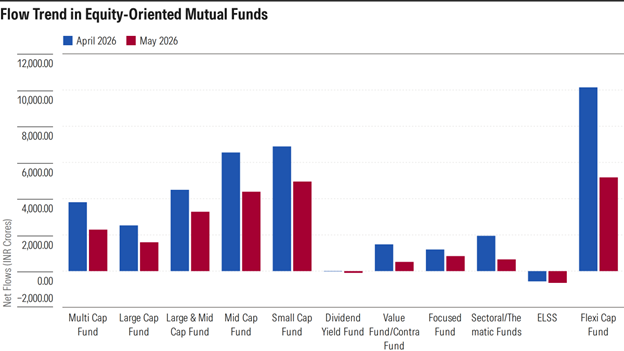
Equity-oriented mutual fund categories witnessed a notable slowdown in investor inflows during May 2026, garnering net inflows of INR 22,908 crore, down around 40% from INR 38,440 crore in April. This also marks the lowest monthly net inflow since May 2025, when the industry attracted INR 19,013 crore. However, viewed in the context of the exceptionally strong inflows witnessed over recent months, the ability of equity funds to attract over INR 22,000 crore underscores that domestic investor participation remains resilient. Over the 12 months ended May 2026, equity-oriented funds have garnered net inflows of INR 364,602 crore.
The moderation in flows can largely be attributed to a combination of factors. Equity markets recovered earlier corrections, reducing the urgency to deploy incremental capital during periods of weakness. Elevated valuations in parts of the broader market along with continued uncertainty around global growth, geopolitical developments, and the path of interest rates appear to have encouraged a more measured approach from investors.
Despite the slowdown, investor preference for broader market categories remained evident. Flexi-cap funds led all equity categories with net inflows of INR 5,176 crore, reflecting continued demand for strategies that offer fund managers the flexibility to allocate across market capitalizations. Small-cap and mid-cap funds also remained among the largest contributors, attracting INR 4,946 crore and INR 4,385 crore, respectively, while multi-cap funds garnered a healthy INR 2,291 crore.
In contrast, inflows into large-cap, large & mid-cap, focused, value/contra, and sectoral/thematic funds declined compared with April, suggesting investors favoured diversified exposures over concentrated bets. Sectoral and thematic funds, in particular, saw inflows decline sharply to INR 648 crore from nearly INR 1,994 crore in the previous month.
The NFO market also remained subdued. Of the 13 funds launched during the month, 12 were passive offerings spanning index funds and ETFs. Together, they mobilized just INR 471 crore, highlighting investors' cautious stance toward new launches.
Overall, the easing in equity fund flows appears to reflect a phase of consolidation after several months of exceptionally strong inflows rather than a deterioration in investor sentiment. Continued inflows across diversified and broader market categories suggest domestic investors remain committed to long-term wealth creation through mutual funds.
Source – AMFI Website
Debt Funds Reverse Course
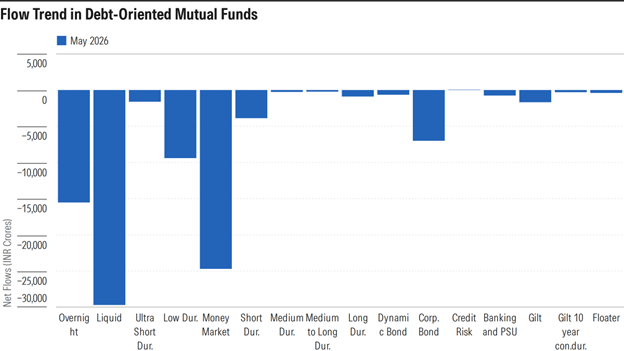
Debt-oriented mutual fund categories witnessed a sharp reversal in May 2026, with net outflows of INR 96,949 crore, following the strong inflows seen in April. The decline largely reflects a normalization phase after the post–fiscal year-end liquidity surge, as institutional and corporate treasuries pared back positions in short-term parking avenues.
The outflows were heavily concentrated in liquidity and treasury-oriented segments. Liquid Funds saw the largest outflows of INR 29,681 crore, followed by Money Market Funds (INR 24,692 crore) and Overnight Funds (INR 15,525 crore). The broad-based decline across these cash management categories largely unwound the sizeable inflows recorded in April, highlighting the transient nature of quarter-begin liquidity deployment.
Short-duration accrual-oriented categories also came under pressure. Low Duration Funds recorded outflows of INR 9,400 crore, while Short Duration Funds saw outflows of INR 3,887 crore, indicating that investors remained cautious despite attractive carry opportunities.
Duration-oriented categories remained under pressure as well. Medium Duration, Medium-to-Long Duration, Long Duration, Dynamic Bond Funds, and Gilt Funds all recorded net outflows during the month, reflecting continued caution around interest rate positioning. Corporate Bond Funds also witnessed notable outflows of INR 7,010 crore, likely driven by profit booking and portfolio rebalancing.
Credit Risk Funds were the only category to attract net inflows, garnering a modest INR 49 crore and extending the gradual recovery seen in April. Overall, 15 of the 16 debt fund categories recorded net outflows in May, reinforcing the broad-based nature of the reversal.
Source – AMFI Website
Gold ETFs Witness First Outflow of the Year
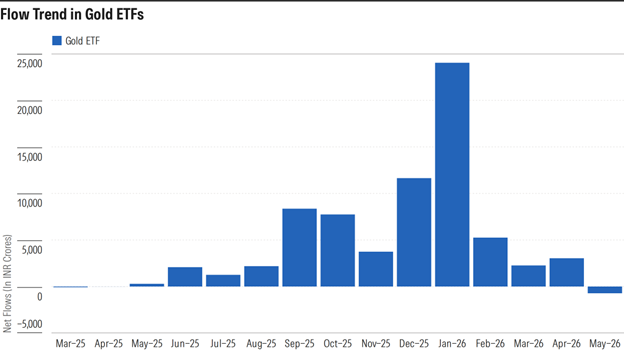
Gold ETFs recorded net outflows of INR 725 crore in May 2026, marking the category's first monthly outflow of the year after a strong start to 2026. The reversal follows a gradual cooling in inflows over recent months, suggesting that investor demand has become more measured after the surge seen earlier in the year.
The outflows appear to have been driven by a combination of profit booking following the rally in gold prices and an improvement in investor risk appetite, with some capital rotating away from safe-haven assets. In addition, the relatively attractive yields available in fixed income may have increased the opportunity cost of holding gold, prompting some investors to trim allocations.
The moderation in flows suggests that investor demand has become more sensitive to price movements and evolving macroeconomic conditions following the strong buying seen earlier in the year.
Source – AMFI Website